
INTRODUCTION
Walk into a modern warehouse in India and you will notice something. Workers are not scanning items one by one. Pallets are being logged automatically as they move through doorways. Inventory counts that used to take three days are done in an afternoon by a single person.
The technology making all of this possible is RFID.
If you have heard the term but are not entirely sure what it means or whether it is relevant to your business — this guide is for you. No jargon. No assumptions. Just a clear explanation of one of the most important technologies in modern business operations.
WHAT DOES RFID STAND FOR?
RFID stands for Radio Frequency Identification. It is a method of identifying objects using radio waves. A small electronic tag attached to an object broadcasts a signal that a nearby reader picks up, identifies, and logs — automatically, without physical contact or line of sight.
That is the core of it. Everything else builds from here.
THE PROBLEM RFID WAS BUILT TO SOLVE
For decades, businesses tracked inventory using barcodes. A barcode scanner must have direct line of sight to the label, reads one item at a time, and depends entirely on the label being clean and correctly positioned. In a busy warehouse or factory this creates constant friction — slow processes, missed scans, and data that is only as accurate as the person holding the scanner.
RFID removes all of these constraints. Multiple items read simultaneously. No line of sight needed. Tags work through packaging. The process can happen automatically without any human involvement at all.
HOW DOES RFID ACTUALLY WORK?
An RFID system has three components — the tag, the reader, and the software. The tag carries the identity of the object. The reader captures that identity when the object moves through its field. The software turns that identity into a business event — a goods receipt, an inventory update, an access record. Remove any one of the three and the system does not work. Combine all three correctly and you have a tracking infrastructure that runs continuously and automatically.
WHAT IS AN RFID TAG AND WHAT IS INSIDE IT?
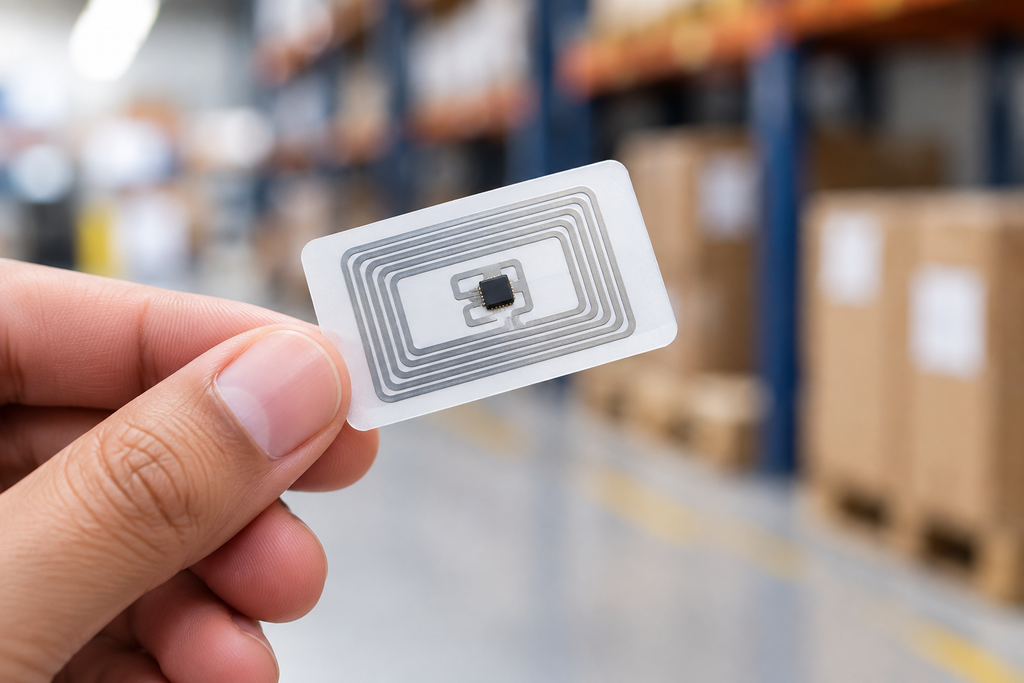
Every tag has two parts — a microchip and an antenna. The microchip stores data. The antenna receives energy from the reader’s signal and broadcasts the stored data back in response.
In most tags there is no battery. The tag is completely passive — powered entirely by the radio signal from the reader. When that signal hits the antenna, it induces a small current that powers the chip just long enough to transmit. The whole exchange takes milliseconds. No battery means no charging, no replacement, no failure from power depletion. A passive RFID tag can last decades.
WHAT IS AN RFID READER AND HOW DOES IT COMMUNICATE?
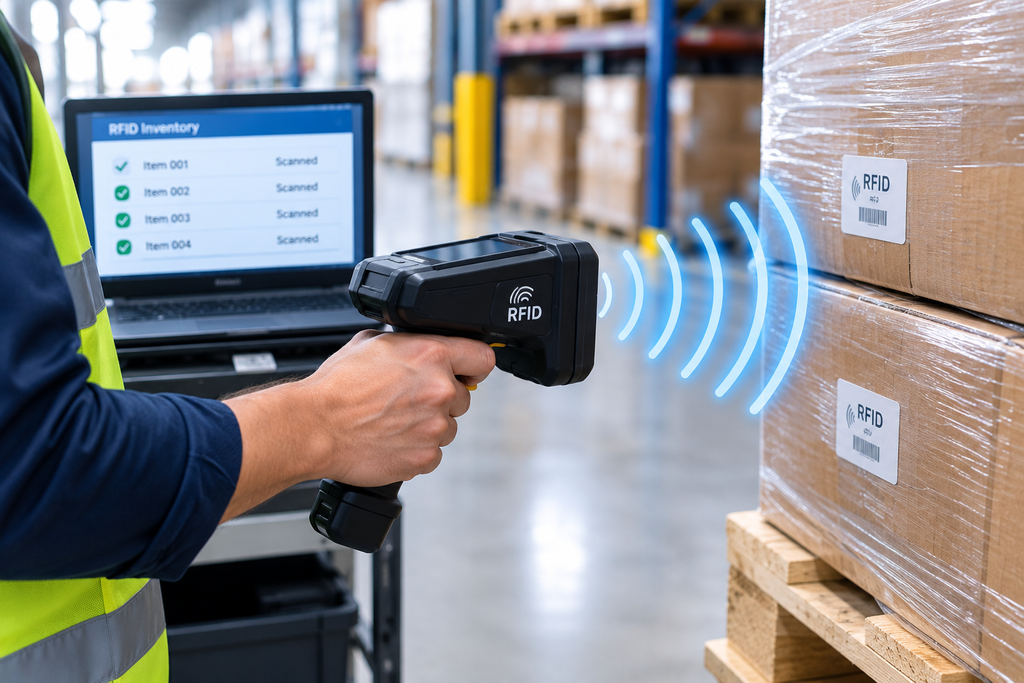
The reader broadcasts a continuous radio signal within a defined range. Any tag that enters that range powers up and responds with its stored data. Readers come in three main forms — fixed readers installed permanently at doorways and conveyor belts, handheld readers carried by operators through a space, and desktop readers used at workstations for encoding and verification. The reader passes captured data to connected software for processing.
HOW DOES THE SOFTWARE TURN RFID DATA INTO BUSINESS INTELLIGENCE?
The software — whether a WMS, ERP like SAP or Oracle, or a custom platform — receives data from readers and turns it into useful information. When a dock door reader scans 200 items on an arriving pallet, the software matches them against purchase orders, updates inventory, flags discrepancies, and logs the event with a timestamp — all before the pallet has cleared the doorway. The tag captures identity. The reader captures the event. The software turns it into intelligence.
RFID FREQUENCIES EXPLAINED — LF, HF, AND UHF
Low Frequency — LF at 125 to 134 kHz
Read range under 10 cm. Used mainly for animal tracking and basic access control. Too slow and short-range for most industrial applications.
High Frequency — HF at 13.56 MHz
Read range up to one metre. Governed by ISO 14443 and ISO 15693 standards. This is the frequency used for NFC — contactless payments, hotel keycards, smartphone tap-to-read. Used in libraries, pharma tracking, patient wristbands, smart cards, and access control. The short read range is an advantage when deliberate, one-at-a-time reading is required.
Ultra High Frequency — UHF at 860 to 960 MHz
Read range up to ten metres plus. Reads hundreds of tags per second simultaneously. This is the dominant frequency for warehousing, supply chain, automotive manufacturing, retail inventory, and asset management — any application where volume, speed, and range matter.
WHAT IS THE DIFFERENCE BETWEEN PASSIVE, ACTIVE, AND SEMI-PASSIVE RFID TAGS?
Passive tags have no battery. Powered by the reader signal. Cheap, thin, long-lasting. The vast majority of commercial and industrial RFID tags are passive.
Active tags have their own battery and broadcast continuously. Read range over 100 metres. More expensive, require battery maintenance. Used for real-time location of high-value assets over large areas.
Semi-passive tags have a battery that powers the chip but still rely on the reader signal for communication. Better performance than passive, cheaper than active. Common in cold chain monitoring where the battery also powers a temperature sensor.
WHAT KIND OF DATA CAN BE STORED ON AN RFID TAG?
Every tag carries a unique identifier — in UHF tags this is called the EPC, Electronic Product Code. Beyond that, tags with additional memory can store batch numbers, manufacturing dates, expiry dates, maintenance records, or authentication credentials. In practice most systems store only the unique ID on the tag and use it as a key to retrieve richer data from the connected ERP or database. This keeps tags simple and cost-effective while the software maintains the full record.
WHICH MATERIALS AFFECT RFID PERFORMANCE — AND HOW?
Liquids absorb radio frequency energy. Standard UHF tags perform poorly on water-filled containers or liquid-filled pipes. Specialist tags with modified antenna designs address this.
Metals reflect radio waves and cause signal interference. A standard tag on steel typically does not read at all. On-metal RFID tags — which include a spacer layer that isolates the antenna from the surface — restore full performance on metallic substrates.
Non-metallic, non-liquid materials — cardboard, plastic, wood, fabric, glass — are transparent to radio waves and present no challenge for standard tags.
Understanding your material environment before selecting a tag type is essential.
THE BUSINESS BENEFITS OF RFID — WHAT ACTUALLY CHANGES WHEN YOU DEPLOY IT
Inventory accuracy from 65 percent to 99 percent plus
Barcode-based systems in real-world conditions typically deliver 65 to 75 percent inventory accuracy. RFID delivers 99 percent plus — automatically and continuously. Every business decision that depends on inventory data becomes more reliable.
Audit time falls by up to 90 percent
Three days with a team becomes two hours with one person and a handheld reader. Higher accuracy. A fraction of the effort. Staff previously consumed by manual counts are freed for productive work.
Labour costs reduce significantly
Every automated read is a manual scan that no longer happens. Businesses consistently report 60 to 80 percent reductions in manual tracking effort after deployment.
Shrinkage and theft fall by 50 to 70 percent
Real-time movement alerts mean unauthorised removal is detected immediately — not discovered at the next stock count weeks later.
Dispatch errors become virtually impossible
RFID verification at outbound gates confirms the right products in the right quantities are loaded before the truck leaves. If anything does not match, an alert fires immediately.
Real-time visibility replaces guesswork
Every asset and every unit of inventory — known, located, and accounted for at all times. Decisions made on current data rather than last week’s count.
ERP integration eliminates manual data entry
Goods receipts, inventory updates, dispatch confirmations, and maintenance records all flow automatically into SAP, Oracle, Tally, or your existing WMS. No manual typing. No delays.
The business scales without overhead growing proportionally
The same infrastructure that tracks 500 assets tracks 50,000. Manual systems break under growth. RFID scales with the business.
ROI typically recovered in 12 to 18 months
Add up the labour savings, shrinkage reduction, audit time savings, and dispatch error elimination. Most deployments pay for themselves within 12 to 18 months.
WHICH INDUSTRIES USE RFID — AND HOW
Manufacturing and Automotive
RFID tracks components through every production stage, verifies quality gate completion, and manages finished vehicle yards. Wavelinx supplies automotive-grade tags to clients including Tata Motors.
Pharmaceutical and Healthcare
Batch traceability, drug authentication, patient wristband identification, surgical instrument tracking, and blood bank management. Wavelinx supplies chemical-resistant and autoclave-safe tags for healthcare environments.
Retail and Fashion
Inventory accuracy of 98 to 99 percent, self-checkout gates, exit-point loss prevention, and fitting room analytics. RFID is one of the largest and most mature retail technology deployments globally.
Logistics and Warehousing
Automated inbound verification, pallet tracking through distribution centres, outbound dispatch confirmation, and real-time client inventory visibility for 3PL operators.
Oil and Gas
On-metal tags on drill pipes, valves, and field equipment survive extreme temperatures, chemicals, and pressure. Drill pipe lifecycle tracking and field equipment management are the primary applications.
Food Processing
Batch traceability from raw material to finished goods, cold chain temperature logging, FSSAI compliance documentation, and allergen control through shared equipment tracking.
Education
Library automation, student attendance, campus access control, and IT asset management across schools, colleges, and universities.
Government and Public Sector
Fixed asset management with CAG-ready audit trails, fleet tracking, sensitive facility access control, and depreciation records replacing manual registers.
Construction
Equipment and tool tracking across large sites, safety equipment compliance, worker access control, and theft prevention at site exit points.
COMMON RFID APPLICATIONS — WHAT BUSINESSES ACTUALLY USE RFID FOR
Asset tracking and management — real-time location and lifecycle management of physical assets from procurement to disposal.
Inventory management — automated stock visibility, cycle counting, and replenishment triggering without manual scanning.
Access control — RFID cards, wristbands, and tags controlling entry to buildings, zones, and equipment with full access logs.
Supply chain visibility — end-to-end tracking of goods through every handover point from raw material to final delivery.
Anti-counterfeiting and authentication — encrypted tags proving product genuineness at any point in the supply chain.
Cold chain monitoring — continuous temperature logging linked to RFID-tagged products throughout storage and transit.
Tools and equipment tracking — check-in and check-out management with calibration scheduling and missing item alerts.
Vehicle and fleet tracking — movement logging, trip records, fuel accountability, and maintenance scheduling.
Document and file tracking — instant location queries and movement alerts for physical records in offices and institutions.
Laundry and linen management — wash-resistant tags tracking uniforms and linens through industrial laundry cycles.
HOW DOES RFID COMPARE TO BARCODES IN REAL-WORLD OPERATIONS?
Line of sight — barcodes require it, RFID does not.
Read volume — barcodes read one at a time, RFID reads hundreds simultaneously.
Accuracy — barcodes deliver 65 to 75 percent in real-world conditions, RFID delivers 98 to 99.5 percent.
Durability — barcode labels fail in heat, moisture, and abrasion. RFID tags are available in industrial variants for extreme environments.
Data — barcodes are fixed at print time. RFID data can be updated in the field.
Item identity — barcodes identify product type. RFID uniquely identifies each individual item.
Automation — barcodes require human scanning. RFID reads happen automatically as items move.
Cost — barcodes are cheaper upfront. RFID delivers ROI within 12 to 18 months through operational savings.
HOW MUCH DOES AN RFID SYSTEM COST?
Passive RFID tags range from a few rupees for standard paper labels to several hundred rupees for ruggedised industrial hard tags. Readers range from a few thousand rupees for basic handhelds to several lakhs for high-performance fixed portal installations. Software and integration costs vary by complexity and existing infrastructure.
The upfront investment in RFID is higher than barcodes. The operational savings — in labour, accuracy, shrinkage, and audit costs — typically deliver full ROI within 12 to 18 months. After that every benefit is ongoing gain.
IS RFID RIGHT FOR MY BUSINESS?
Ask yourself these questions honestly.
How much time does your team spend counting and reconciling inventory each week? How accurate is your current inventory data — and what do decisions made on wrong data cost you? How often do assets go missing, and what does finding or replacing them cost? How many dispatch errors happened last year?
If the answers to those questions add up to a significant number — RFID is very likely worth a serious evaluation. For most businesses managing more than a few hundred assets or SKUs in a dynamic environment, the numbers make a compelling case.
CONCLUSION — GETTING STARTED WITH RFID IN INDIA
RFID is not complicated once you understand its principles. A chip stores data. An antenna communicates it. A reader captures it. Software turns it into intelligence.
What makes it powerful is the combination — passive tags with no maintenance requirements, readers that work automatically as items move through normal operations, and software that delivers real-time visibility across the entire business.
Wavelinx Technologies has been manufacturing RFID tags, labels, and inlays from our ISO 9001:2015 certified facility in New Delhi since 2011. NFC, HF, and UHF tags across standard, on-metal, high-temperature, and custom variants — supplied to over 100 clients across automotive, pharma, logistics, retail, oil and gas, and more.
If you want to understand which RFID solution makes sense for your specific application, we are happy to have that conversation.